

Doing something horribly wrong
The urgency to have no prime and constantly evolve.


It's Monday. You opened LinkedIn and before you'd finished your first coffee, someone had already raised $40 million, announced a $100M ARR milestone, and posted a thoughtful seven-paragraph reflection on "staying hungry."A founder who graduated university three years ago just rang the bell on their Series B.
And you’re sitting there thinking everyone else has it figured out.
They don’t. And I don’t mean that in the motivational-poster, “failure is just growth in disguise” way.I mean it in the forensic, audited, let’s-look-at-the-actual-numbers way.
$124 Million, $600,000 in Revenue, Dead in 72 Hours
Fast | 2022
Let me set the scene.
It’s early 2022. A payments startup called Fast has raised $124 million from some of the most credible names in fintech. Stripe is an investor. Index Ventures wrote a cheque. The founder, Domm Holland, is giving interviews, doing stages, getting the kind of coverage that makes the LinkedIn algorithm purr.
The premise: one-click checkout. You’ve bought something on Amazon and hit that effortless yellow button. Fast wanted to bring that experience to the rest of the internet. Checkout abandonment rates consistently sit above 70%. Own the moment between intent and purchase, and you own something genuinely valuable.
The strategy looked coherent on paper. The playbook was classic fintech: get merchants to install the Fast button, build a network of returning buyers across sites, monetise the transaction volume. Network effects would compound. Merchants would follow consumers. Consumers would follow ease.
Then Techcrunch reported on the shutdown on April 5, 2022, and one number stopped people mid-scroll.
Fast was generating approximately $600,000 in total revenue. Against a burn rate of roughly $10 million a month.
That is not a growth-stage company investing ahead of revenue. That is a different mathematical category altogether. The company shut down within 72 hours of announcing it was exploring “options.” Eighteen months of runway, $124 million, and a team of talented people, gone in a week.
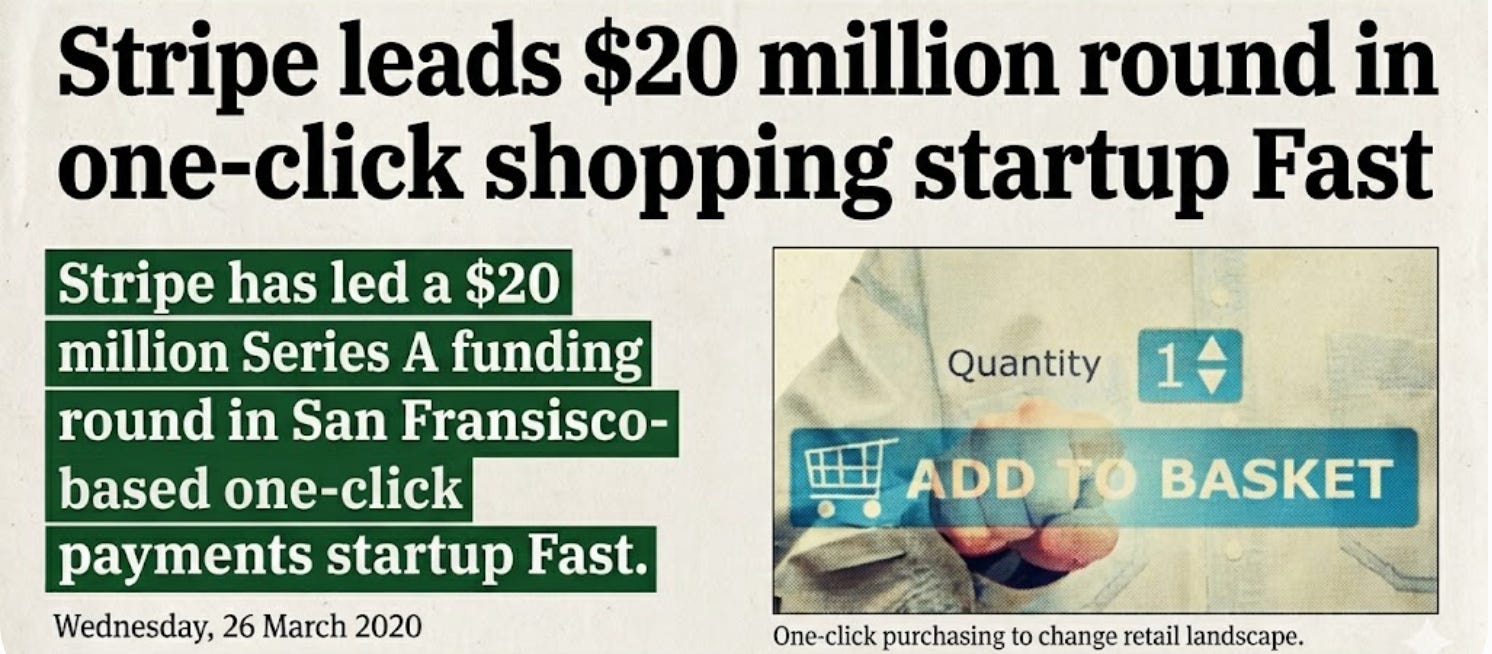
Image from Finextra article
The planning fallacy
What you’re watching is a textbook case of what researchers call social proof cascading into optimism bias. When Stripe, one of the most operationally rigorous companies in payments invests in your checkout startup, it sends a signal. Other investors read that signal and think: if Stripe sees it, we should too.
Nobody pauses to ask the somewhat obvious question that Stripe has direct strategic incentive to invest in or acquire potential competitors to its own checkout products.Their cheque wasn’t necessarily a thumbs-up on Fast’s unit economics. It may have been a hedge. The motivations of an anchor investor are not the same as a business model endorsement.
Then there is the problem that the psychologist Daniel Kahneman spent much of his career documenting: what he called the planning fallacy —
the systematic tendency to underestimate costs and overestimate outcomes, even when the data is already pointing somewhere uncomfortable.
Fast’s leadership appeared to believe they were in an investment phase that would eventually resolve into a viable business. The merchant adoption numbers weren’t cooperating with that belief. The belief continued anyway.
The 72-hour shutdown is its own behavioural footnote. Once the narrative broke, there was nothing structural left to hold the company upright. Startups run on narrative as much as capital. Remove one and the other follows quickly.
If you’ve had a week where your numbers were bad, where something you built didn’t land, where a strategy you believed in utterly failed to find traction, you were in similar epistemological territory to a $124M-backed company. The scale is different. The fundamental problem of conviction outrunning evidence is not.
Two Giants, One Vision, $3.6 Billion, Zero Cars
Argo AI | 2022
Here is a thought experiment.
Imagine two of the largest car manufacturers in the world, Ford and Volkswagen decide to stop competing on autonomous vehicle technology and instead jointly fund a single company to solve it for both of them. Together they invest $3.6 billion. They hire some of the best robotics and AI engineers on the planet. They give it five years.
Now imagine that five years later, they shut it down. Entirely. In a week. With 600 engineers out of work.
That is Argo AI. Ford invested first in 2017. VW joined in 2020, contributing $2.6 billion to bring the total to roughly $3.6 billion. Argo was building a Level 4 autonomous system — no human required — for deployment in commercial ride-hailing and delivery across both manufacturers’ fleets.
The strategy was actually more considered than most autonomous vehicle bets. While Tesla and Waymo were going consumer, Argo was going commercial and urban, with two enormous OEM distribution channels already locked in. If it worked, you skip the go-to-market problem entirely. Ford deploys it. VW deploys it. You have a captive route to scale that most AV startups would spend years trying to build. On paper, it was a structurally intelligent position.
The economics of why it failed are the part that doesn’t get discussed enough.
The problem with self-driving isn’t the core software. It’s the edge case economics. A deployable autonomous system needs to handle not the average road scenario but the long, expensive tail of unusual ones, for example - a child’s football rolling into the road, construction zones with no lane markings, a police officer directing traffic by hand. Every edge case requires more data, more compute, more training cycles, more engineering time. The cost curve doesn’t flatten as you progress. It steepens.
After five years and $3.6 billion, Argo was still years from commercial deployment, and the capital required to close the distance had not decreased, it had grown.
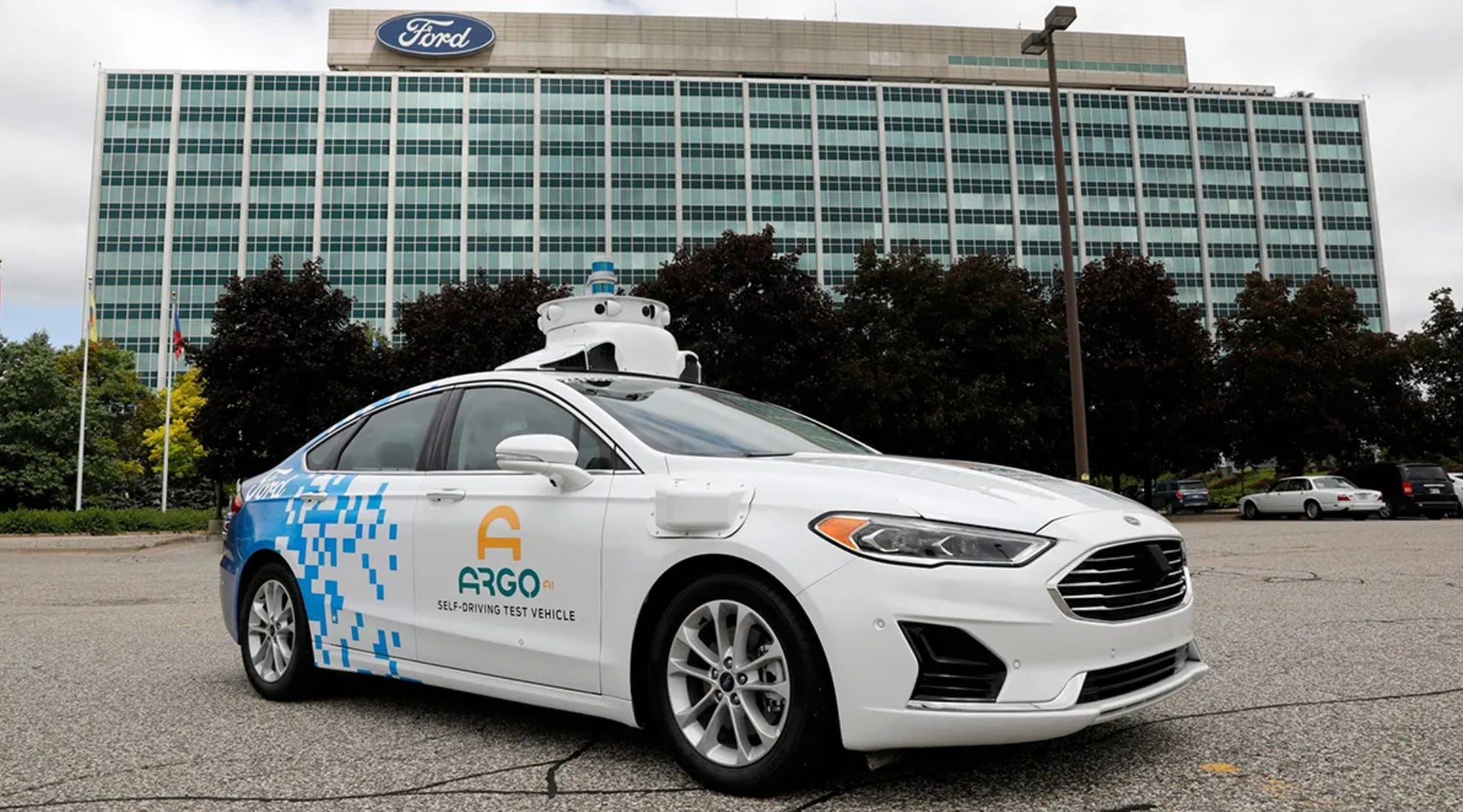
A Ford Argo AI test vehicle parked in front of the Ford headquarters in Dearborn. Source- Bloomberg News
The Sunk Cost Fallacy
What you’re watching is the sunk cost fallacy operating at industrial scale. For years, both Ford and VW found it difficult to stop funding Argo not purely because the returns still looked compelling, but because so much had already been committed. The existing investment became its own justification for continued investment. Stopping felt like admitting the original decision was wrong. Continuing felt like preserving optionality, keeping a seat at the table, not being the one who blinked.
Kahneman and Tversky documented this tendency decades ago that:
humans, and the institutions built from them, systematically make future decisions based on costs already paid rather than honest assessments of expected future value.
The rational decision, several analysts argued at the time, was to wind down Argo in 2020 or 2021, when the edge case problem had become structurally clear. But $3.6 billion creates its own gravity.
Argo AI’s co-founder Bryan Salesky posted a farewell note on LinkedIn that was strikingly direct. He did not blame the technology. He acknowledged the capital reality.
If you’ve ever stayed in a project, a strategy, a role, or a relationship longer than you should have because of how much you’d already put in, you were doing exactly what Ford and VW did. With considerably less money, but with the same brain, running the same calculus.
A $7.75 Billion Company That Sold for $15 Million
Hopin | 2021–2023
This one requires a brief time machine.
It’s 2020. The world is in lockdown. Every conference, every launch event, every networking dinner has been forced online. A virtual events startup called Hopin, barely a year old is growing at a rate that looks like infrastructure for a permanent new normal.
Tiger Global led a round that valued Hopin at $7.75 billion in 2021. Not a side bet. A conviction play from one of the most aggressive growth funds in the world, whose entire thesis was: move fast, overpay slightly for the category leader, get in before the multiple compresses. Applied to Hopin, it looked prescient. The growth charts were vertical. The narrative was airtight.
The strategy made a particular kind of sense in context. If remote work and remote events became structurally permanent, a genuine hypothesis in late 2020, then owning the infrastructure layer for virtual gatherings was an enormous market. Hopin’s growth appeared to validate the premise month after month. The round made sense as a bet on the continuation of a behavioural shift.
The economics of what followed are a near-perfect case study in multiple compression.
When Tiger led at $7.75B, the market was rewarding revenue multiples at levels that had no precedent in the history of venture capital outside a handful of best-in-class SaaS companies. Growth was being capitalised as if the pandemic pace would continue indefinitely. When vaccines arrived and the world reopened, Hopin’s usage dropped almost as sharply as it had risen. The narrative evaporated. The revenue base contracted. The company began selling off product lines.
In June 2023, RingCentral acquired Hopin’s Events product. TechCrunch reported the acquisition — for approximately $15 million.
From $7.75 billion to $15 million. In two years. On the same product, with the same team, in the same category. The only thing that changed was the story the market was willing to pay for.
Image from the hopin.com website
Narrative Investing
What happened to Hopin’s investors is a demonstration of what behavioural economists call narrative investing — capitalising a story rather than a business. The story was: remote is permanent and Hopin owns it. The business was a virtual events platform whose retention characteristics were entirely tied to an unprecedented global situation. When the situation normalised, the story collapsed. The business underneath, stripped of the narrative, was worth $15 million.
Investors are not immune to this.
They are, arguably, structurally susceptible to it because the entire venture model requires conviction in a future state of the world that doesn’t exist yet. That conviction is a feature when you’re right.
It is catastrophically expensive when the future you’re pricing in turns out to be contingent on a global pandemic lasting indefinitely.
There’s a concept sometimes called scenario anchoring — once you’ve committed financially and intellectually to a particular version of the future, you filter incoming evidence through that lens rather than genuinely updating on it.
The signals that Hopin’s growth was pandemic-specific, rather than structural, were available and visible. They were not weighted appropriately.
Tiger Global as a whole lost approximately $17 billion in 2022, making it one of the worst fund years in hedge fund history, as reported by The Business Insider. Hopin was one piece of a much larger and more expensive reckoning with the same underlying problem: a compelling story, capitalised as fact.
So Where Does That Leave You?
Three investments. $124 million. $3.6 billion. $7.75 billion.
All that turned into allegedly bad investments. All made by institutions with more information, more research, more structural support, and more experience than almost any individual making a call on a Monday morning. None of them disclosed in a keynote. All of them educational in ways that success rarely is.
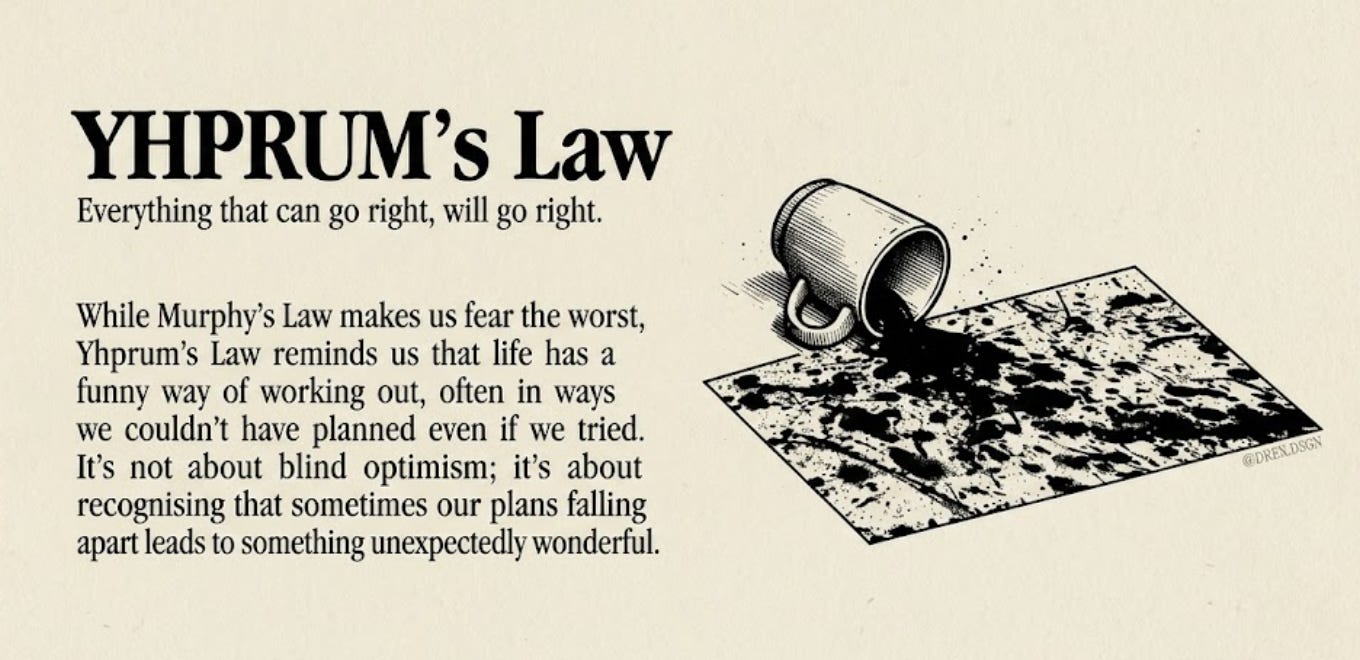
Source: Pinterest
The psychologist Carol Dweck spent decades studying what separates people who grow through failure from those who are stopped by it. Her conclusion, painstakingly documented across years of research, is that:
It isn’t intelligence or resources or circumstance, it’s whether you believe ability is fixed or whether you believe it can be developed.
The investors above lost billions and are, largely, still in business. Not because they are reckless, but because they treated the failure as information rather than verdict.
You are still in the game. You are still gathering information. The people on your LinkedIn or twitter feed who look like they have it completely sorted have chapters they haven’t posted, bets that didn’t land, strategies that sounded right at 9am and were visibly broken by 3pm.
Show up. Do your work. Fail at it sometimes. Don’t get stuck on the failing. The smartest money in the room does it too, they just get to call it a write-down and move on. So should you.
Have a great week ahead.
Team AI+
One thing that resonated with me is how often we confuse being "prepared" with being "ready." In reality, most meaningful work is shipped while we're still figuring things out.
The internet tends to showcase polished outcomes, which makes it easy to forget that almost every successful project started as a rough, incomplete version of itself. The willingness to do something badly at first is often the price of eventually doing it well.
I also liked the implicit reminder that feedback comes from action, not planning. You can think about a problem for weeks, but a single imperfect attempt usually teaches more than another round of analysis.
Thanks for putting words to something many builders experience but rarely articulate.