

The first people AI is paying aren’t programmers. They’re mothers.
A Monday read on India's accidental new export: human hands, by the hour.

A few years ago, everyone had the same prediction.
AI would replace software engineers.
Then lawyers.
Then writers.
Maybe doctors.
Nobody’s bingo card had this.
The hardest job to automate would be folding a towel.
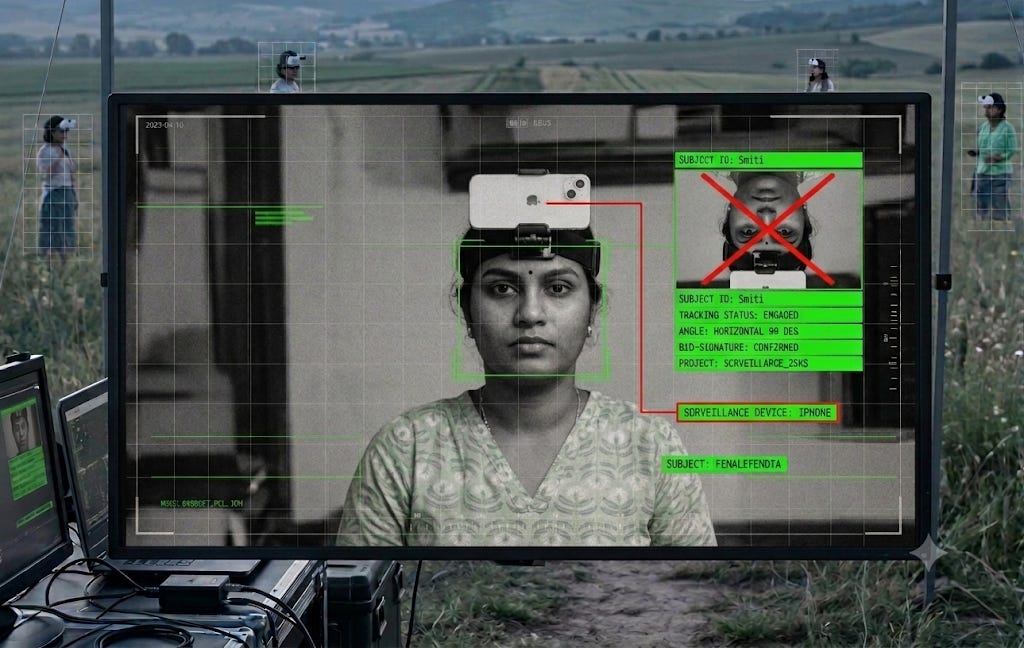
Somewhere in Chennai this morning, a woman straps a small camera to her forehead, slices a mango, folds a shirt, wipes a kitchen counter, and earns around ₹250 an hour (equivalent to $2.60).
Not because she’s making content. Not because she’s live-streaming.
Because somewhere, thousands of kilometres away, a humanoid robot is trying to learn how her hands move.
That sentence sounds absurd.
It’s also completely real.
An AI data company called Objectways has been hiring people across India to wear head-mounted cameras while doing ordinary household tasks.
About ninety recordings a day. Four minutes each. Fold a towel. Arrange a bed. Pick up bottles. Slice fruit.
In Bengaluru, a flower seller records herself making garlands between customers to earn extra income. In Chennai, women are filming routines they’ve repeated thousands of times over decades. This footage eventually becomes training data for humanoid robots.
For years, Silicon Valley sold us one story.
AI would replace repetitive work.
I’m beginning to think the opposite is happening.
The first things AI mastered were the glamorous ones.
Writing essays.
Generating code.
Passing exams.
Playing chess.
Meanwhile...
Holding a slippery mango.
Folding a bedsheet.
Buttoning a shirt.
Picking up a half-full glass.
Those have turned out to be some of the hardest problems in artificial intelligence.
That’s deeply ironic.
For decades we assumed intelligence lived inside universities, boardrooms and research labs.
Turns out an uncomfortable amount of it was quietly sitting inside our homes.
Sketchplanations
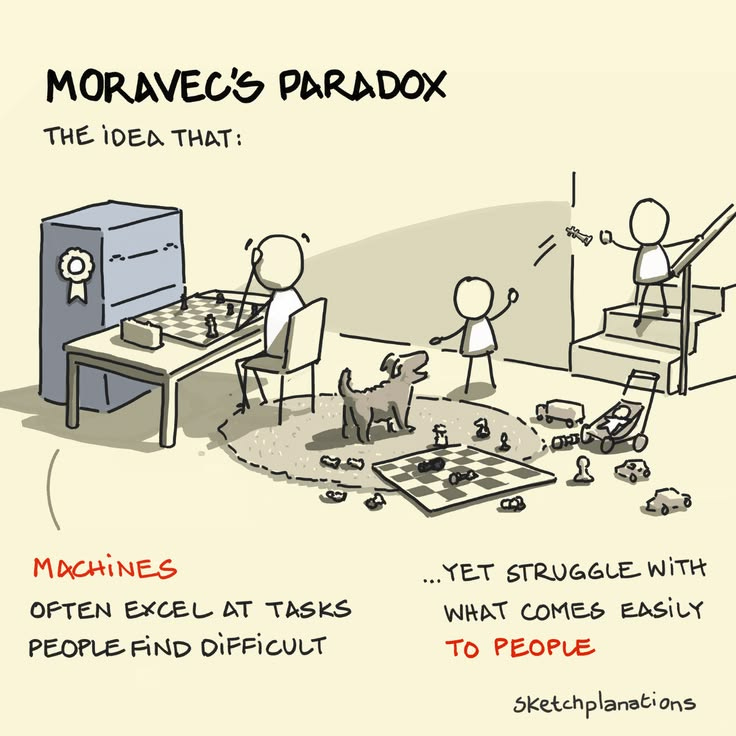
Robotics has known this for decades. There’s even a name for it. Moravec’s Paradox. The paradox is wonderfully humbling.
The things humans struggle with- advanced mathematics, chess and logic are relatively easy for computers.
The things a one-year-old learns without ever opening a textbook?
Those are a nightmare. A robot can explain quantum mechanics. Then fail to load your dishwasher. It can defeat a chess grandmaster. Then struggle to pick up the chess pieces.
For all the headlines around humanoids this year, the reality is surprisingly messy.
Tesla’s Optimus can fold laundry under carefully controlled conditions, but even Elon Musk admitted earlier this year that the robots inside Tesla’s own factories still aren’t doing useful work.
Figure AI has made remarkable progress, yet something as ordinary as folding a T-shirt remains one of robotics’ favourite unsolved problems.
Why is the gap this stubborn. UC Berkeley roboticist Ken Goldberg ran the numbers and found something almost funny. The text used to train today’s large language models would take a human roughly 100,000 years to sit and read. that is the scale of human experience it took to teach a machine to write and reason and beat us at chess.
There is no equivalent internet for touch. no scraped archive of how a hand decides, in a fraction of a second, exactly how hard to grip a mango so it doesn’t bruise or slip. So the industry that solved language by reading everything humans ever wrote is now short of the one thing it cannot scrape off a server: millions of hours of an ordinary human body doing ordinary things, on camera, from the first person.
It’s almost funny.
Human civilisation spent centuries celebrating extraordinary intelligence.
AI is revealing that ordinary intelligence may have been extraordinary all along.
Here’s the part that fascinated me the most. The woman in Chennai isn’t being paid to clean. She’s being paid for something much stranger. She’s being paid for decades of unconscious expertise.
Think about how you tie your shoelaces. Or unlock your front door. Or peel a banana. You don’t consciously calculate angles. Pressure. Grip. You just know.
Years of tiny corrections have been compressed into instinct.
The AI industry has reached a point where it isn’t buying labour anymore. It’s buying muscle memory.
It isn’t paying people to perform tasks. It’s paying people to reveal knowledge they didn’t even realise they possessed.
That’s a profound shift.
There’s another irony hiding underneath all of this.

India’s latest Time Use Survey found that women spend an average of 289 minutes every day on unpaid domestic work. Men average 88 minutes. Economists estimate that this invisible labour contributes somewhere between 15–17% of India’s GDP.
For generations, society called it “Just housework.”
No salary.
No performance review.
No job title.
No line on a résumé.
Then artificial intelligence showed up. Suddenly the exact same work had a market rate. The first industry willing to consistently pay for folding laundry wasn’t economics.
It wasn’t government. It wasn’t society.
It was robotics.
That should make all of us slightly uncomfortable. Because AI may end up valuing invisible labour before humans ever did.
But there’s another thought I can’t shake. Maybe we’ve misunderstood what automation actually does. Every technological revolution doesn’t simply replace work.
Sometimes it exposes work we never noticed in the first place. We thought intelligence was solving differential equations. Maybe intelligence is knowing exactly how tightly to grip a ripe mango without bruising it.
We thought expertise looked like someone writing code. Maybe expertise also looks like someone making a bed in under two minutes because they’ve done it ten thousand times.
The more AI learns about humans, the more it seems to uncover forms of intelligence we’ve spent decades overlooking.
One day these robots will probably fold towels better than we can. History suggests they’ll eventually get there. I’m not particularly worried about that.
The question keeping me awake is a different one.
Why did it take a trillion-dollar AI industry to convince us that the person folding the towel was highly skilled in the first place?
Maybe that’s the real lesson hiding inside all of this. AI isn’t just learning how humans work. It’s forcing humans to notice themselves.
And I can’t help but wonder...
What other forms of “ordinary” intelligence are we still dismissing today, simply because we’ve lived beside them for too long?
This piece perfectly captures one of the biggest ironies of the AI era: the future isn't being built only in research labs or boardrooms—it's being built in ordinary homes by people doing ordinary things. The fact that everyday human experiences and movements have become valuable training data is both fascinating and unsettling.
What struck me most is that this isn't just a story about AI or robotics. It's about how the invisible work of millions of people is quietly becoming the foundation of the next technological revolution. History may remember the companies that built the robots, but it should also remember the people who unknowingly taught them how to be human.
Brilliantly written. Thank you for highlighting a perspective that's easy to overlook.